


On July 28, 2026, the Seminar on Capacity Building in Work Safety Supervision and Law Enforcement for Belt and Road Countries, an overseas aid training program sponsored by the Ministry of Commerce and undertaken by the International Exchange and Cooperation Center of the Ministry of Emergency Management, opened in Beijing. 35 work safety regulators from 7 Belt and Road partner countries, namely Armenia, Benin, Egypt, Grenada, Jordan, Laos and Mongolia, participated in the training. As the technical support institution, China Quality Certification Centre (CQC) gave special thematic lectures.
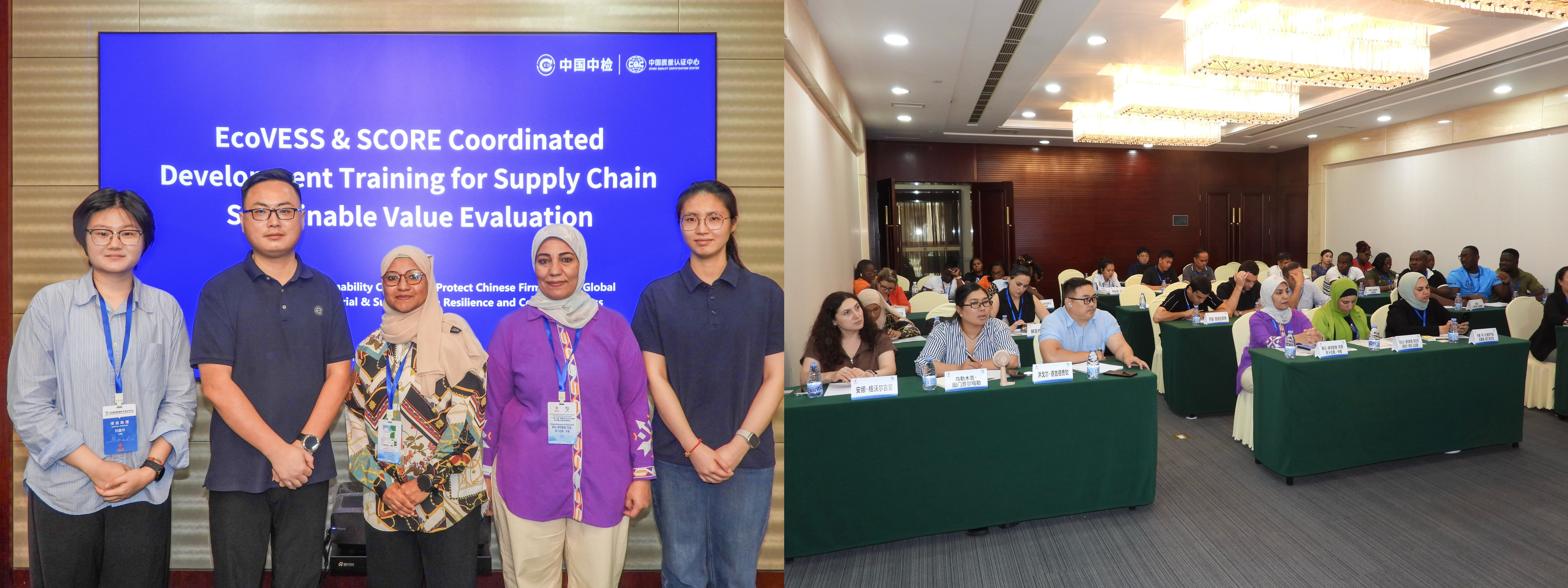
Based on the new landscape of global supply chain supervision, ESG experts from CQC systematically explained the integrated application approaches and practical implementation cases of EcoVESS (Sustainable Value Evaluation System for Supply Chain Enterprises) and the SCORE Total Worker Safety Management Model, focusing on China’s international cooperation policies for work safety and practices in building sustainable supply chains. The lecture offered a tailored "Chinese solution" aligned with the industrial realities of Belt and Road partner countries to help them improve domestic work safety control, occupational health protection, and sustainable supervision systems across entire industrial chains.
EcoVESS is an evaluation system independently developed by CQC. It is designed to measure the sustainable value and ESG performance of supply chain enterprises within the value chain. Its indicators comprehensively cover seven dimensions of supply chain sustainable development: organizational governance and business conduct, environment and climate, product and customer responsibility, value chain responsibility management, labor and rights, operational resilience and innovation, as well as social impact and contribution.
Going forward, CQC will continue to deepen cooperation with all stakeholders, actively respond to the practical needs of Belt and Road partner countries, and focus on supply chain safety, green and low-carbon development, occupational health governance and other areas, helping these countries consolidate the foundation for sustainable development of their industrial chains.